Sunday, June 6, 2010

Chemical Warfare Pt.4: Weed patch 2

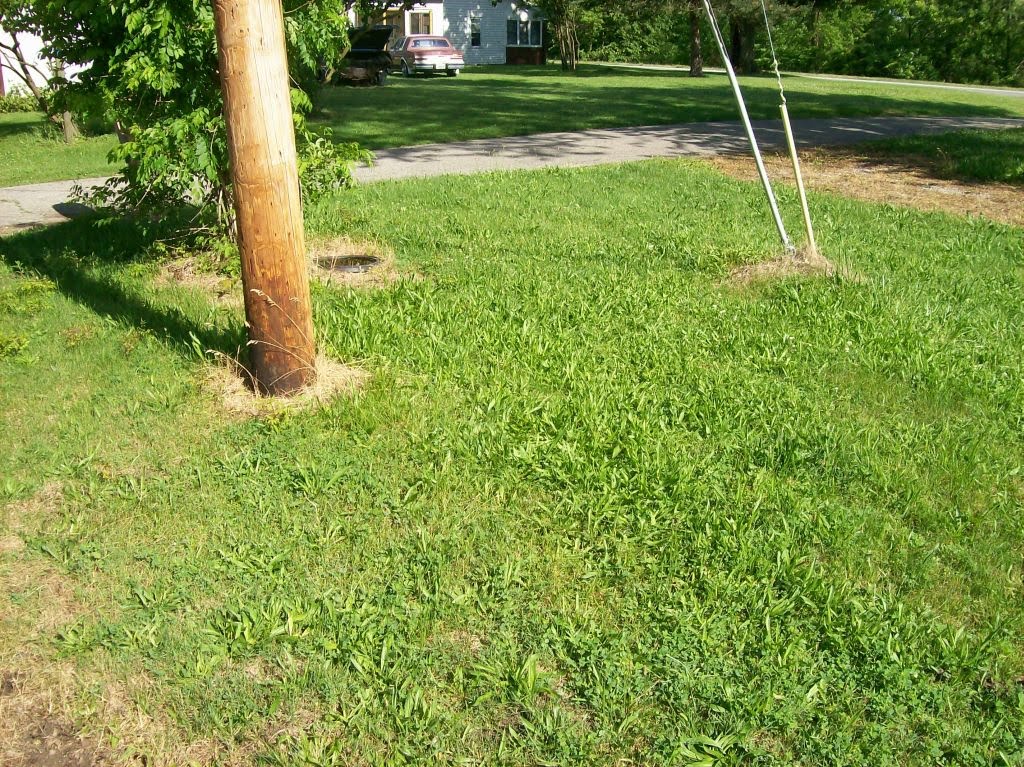
Behold, most likely the weediest part of my entire lawn... And guess what: It's right in my front yard! Just before I posted this I sprayed all the weeds with broadleaf herbicide, so I can overseed it next month.
Just so you know the brown patches are areas that I "rounded up," so I didn't have to trim them. Other than some powdery mildew I don't seem to have a lot of lawn diseases.


Update on Weedy Patch 1:
As promised here is a picture of my first weed patch, minus the weeds. Over the course of the last month I applied Weed-B-Gon and Grub-Ex, then waited. As before this area is mole haven, now more so than before. I get the feeling that since I killed off the grubs the moles are working overtime looking for food...
Today I overseeded this area with Kentucky Bluegrass and fertilized it with 12-12-12. Hopefully I have better luck here than I did in my burn-down patches (which are growing some sort of "weed" grass)


And just a note about consumer herbicides:
Since my initial interest in lawn improvement I've done a lot of research into herbicide... If you have ANY concerns about the enviroment, public safety and/or your budget, DO NOT buy or use consumer broadleaf herbicides! Most, if not all, contain Dicamba, a chemical which by design does NOT break down in soil! This means that it will leach into the water table, and possibly before that "hit" desirable plants!!! Most also contain Mecopop, which is similarly persistant.
If you're reading this and want to kill the broadleaf weeds in your lawn, go to Tractor Supply or a similar agricultural supply store and buy straight 2,4-D acid. It readily breaks down in soil (with an average half-life of 7 days), and unless it comes into contact with your eyes is more or less harmless to humans and most animals. 2,4-D is also less expensive per application than most weedkillers, and makes good economic sense. Just remember that straight 2,4-D is just that, and does NOT contain a surfactant. I add an ounce of Tide per gallon to my 2,4-D mix; it may smell weird but it does seem to help with the absorbtion of the herbicide.

Wednesday, May 19, 2010

Chemical Warfare Pt.3: Weed Patch 1

Well it's done. Today I sprayed the weed patch with broadleaf herbicide. The patch wound up being bigger than I thought (nearly half the size of my garden!). However it went very quickly. I used a mixer-sprayer to spread the herbicide, and in all honesty I think it took longer to clean the sprayer than it did to spray the weeds!
I should be able to overseed the area in about a month. I will be applying grub-killer at about the same time. I'll post again after the herbicide has had it's effect, and show the weedy patch (sans weeds, of course...)
It may sound wierd, but I love the smell of 2,4-D in the morning. To me it smells like... Victory... (just kidding, actually the smell reminds me of the now gone Sand Ridge nursery. Actually the Weed-B-Gon concentrate does not contain 2,4-D but the premix that I used on my thistles does, and it smells JUST like the greenhouse.)

Sunday, May 16, 2010

Chemical Warfare Pt.2

Finally, after two weeks, the results of my burn-down are visable for all to see. I already have my seeds spread, watered-in and (in the case of the second burn-down area) mulched. Here are the results:
Burn-Down area 1:


Burn-Down area 2:

Both patches have been planted with Pennington Kentucky Bluegrass blend (like all grass seed it is mechanically mixed seed, however all of the seed in this perticular blend is varieties of Kentucky Bluegrass). The second area I mulched with partially rotted grass clippings, with less than ideal results. I decided to leave the first area unmulched for now, and hope it works out...


Next problem: Weedy patch 1
This is one of the weediest areas of my entire lawn, and not all of it fits in the picture! Mixed broadleafs dominate this area; and there is virtually no grass here. Between this and the massive mole activity (you can see at least two of the mole-tunnels I water-drilled), as well as the two that I actually saw, I think this area is infested with grubs.
The plan is to spray this entire area with a broadleaf herbicide, overseed with Kentucky Bluegrass, and in the mid-to-late summer treat the area with grubkiller... If I have to mow it anyways I may as well mow GRASS! Not weeds!

More soon, hopefully after my seeds sprout...

Sunday, May 9, 2010

Burn-Down: Week 1

As you can see the burn-down is not going quite as well as can be expected... Personally I blame incomplete mixing of the herbicide and poor spraying technique. I believe I have resolved both by the simple addition of red food coloring to the mix. By mixing just enough red color into the Round-Up to make it look like cherry Kool-Aid both the spray itself and the coated plants are far more visable, and by coloring the herbicide it's easier to judge weather it's properly mixed or not. I re-sprayed the remaining green patch earlier today, and will likely seed this area sometime this week...

BTW the burn-down in the other previously pictured area is also going about this badly; I decided not to waste Google's web space by posting a picture of it. I'll post once the results are more dramatic.

Saturday, May 1, 2010

Lawn Renovation: BURN IT DOWN!!!

Okay. I hate my lawn. It's official.
Aside from the fact that I have to mow it, it's patchy, weedy, and overall inconsistant. I have "jungle" areas that grow at rediculous rates, near-dead areas that have only a few grass plants, and areas that are practically solid weeds...

This means WAR!


When faced with a problem lawn like this, I feel that I am left with only one option: BURN IT DOWN!!! MWAHAHAHAHAHA!!! MWA HA HA HA!!!

Er... Sorry about that...

Lawn Renovation part 1: The Burn-Down
In agriculture a burn-down doesn't involve literally igniting anything, rather the use of a broad spectrum non-persistant herbacide, such as Round-Up, to kill all existing plants in preperation for planting. This prevents weeds and non-desirable grasses from outcompeting the desired plants.
All Round-Up that is not absorbed by plants rapidly breaks down into harmless materials, allowing the "burnt" area to be reseeded in as few as three days. Since the existing plants are dead they don't compete for sun and soil nutrients, allowing the new planting to thrive.
I am currently burning down two areas of my lawn, which are pictured below. Next weekend I plan on replanting them...


Part 2: Soil enrichment
I have a strong suspicion that my soil has inconsistant nutrient levels. This is solved by applying fertilizer. Using a handheld broadcast spreader I generously applied triple-12 fertilizer to both of the burn-down areas, and hopefully with the rain predicted over the next few days it'll be thuroughly absorbed into the soil by the time I have seed ready.
Normally fertilizers like this can "burn" plants, due to their high nitrogen content, but considering that I'd already applied Round-Up to the grass I doubt if this is a serious concern...


Part 3: Re-Plant
This will be covered in the next post...


Replanting Area 1: The "pool"
The previous owner of the property had a swimming pool on this portion of my lawn. The grass is very spotty, and my attempted re-planting last year failed miserably. I have higher hopes this year...


Replanting Area 2: The Back Yard
This is one of the poorest areas on my lawn. And yes, it's worse than it appears in this picture. Weeds dominate this patch, and the grasses are scraggly and short. The short part doesn't bother me, but the weeds do...

These are only the first two portions of my lawn that I plan on replacing. Eventually I'd like all of my lawn that I don't plan on putting into production (gardening and home-farming) to be Kentucky Bluegrass, but I plan on doing this peace-meal. These two plots are the experiment, and more likely than not all I'll actually replant this year. I may change my mind, but I have other projects that to me take precedence...

That's all for now. More will be posted over the next week.

Tuesday, November 10, 2009

House Update: Insulation (FINALLY!!!)

I am now entering my third year of home-ownership, and FINALLY I have some real insulation in my house!
In review: Since I purchased this house I have overwintered it twice, and in the process burned about 1,600 gallons of Liquefied Petroleum Gas, 1,500 pounds of Anthracite coal and 10,000 kilowatt-hours of electricity to keep it heated, at an estimated annual cost of over $1,0o0! Considering that my house is only 750 square feet this is utterly ludicrous in my opinion!
So far the addition of a new high-efficiency furnace and Harman Magnafire Mk.1 coal stove have helped immensely in my heating costs, but the fact of the matter is that up until about three weeks ago my house had literally no insulation!
My parents and I agreed that this was unacceptable, so about three weeks ago my father and I spent the morning blowing in shredded fiberglass bedding into my attic. I had expected to get about a foot of bedding in within reasonable costs, however owing to the small size of my house we got close to three! In technical terms we increased my attic insulation by an order of magnitude; in my opinion we went from R-6 to R-60.
Even now the insulation seems to be making a difference; on sunny days I haven't had to run the stove at all, regardless of the nighttime low. And on the colder days so far I have only had to run the stove at the bare minimum to keep the anthracite lit! At least so far my heating time from a single 50lb bag of coal has almost doubled...
All I am certain of is that winter is coming... Hopefully my insulation makes as big of a difference as I am hoping for; last year my furnace only kicked on when it was either rediculously cold (as in 13 below zero, when my stove was running near maximum output and the furnace STILL kicked on!) or when the stove went out... I am half expecting, half hoping that with a little care on my part that the furnace never kicks on this winter, and that I burn between half and two thirds of the coal that I did last year. And considering the improvement in insulation I don't think that this is unreasonable.

Sunday, April 26, 2009

Black Jack

Meet Black Jack.

I finally made the decision about three weeks ago to adopt a second cat to keep Chessie company... It is important to realize that on average I am away from home between 9 and 16 hours a day between my work, my hobbies and my volunteer work for the TLEW railroad... I had come to realize that I was not home (and awake) enough for Chessie's benefit, and that there was only one solution to the problem: Adopt another cat.
Both Chessie and Black Jack are from the Friends of Felines Rescue Center near Defiance, OH (and both more or less grew up there together; they are almost exactly the same age). After three days of intense stand-off they began to get along, and are now "close friends." Adopting Black Jack has definately fulfilled my reasons for getting a second cat; Chessie is far less troublesome than she was, and I haven't had a cat scratch since the evening I walked in with the cat carrier... This is a very significant improvement!
The only reason that I havent posted this earlier is because the last time that I had a chance to post (when I got my chickens, see my hobby blog) Black Jack had mysteriously vanished... After an hour of searching I finally discovered that he had found his way into the crawlspace via an insecure vent... He found his way back down there several more times (once for at least six hours) before I was able to blockade the vent. Once I bolt the vent down this will no longer be a problem...
Unlike Chessie, who is outright ornary, if not crazy, Black Jack is a very calm-mannered cat who is perfectly contented to sit back and relax. I think this may already be rubbing off on Chessie (I sure hope so anyways...)